

PlaySportsTV Gymnastics
Repetition is Pivotal with Girls' Gymnastics Training
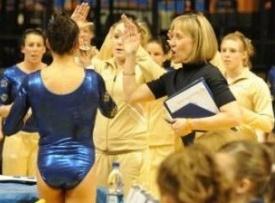
University of Pittsburgh coach Debbie Yohman congratulates one of her gymnasts.

Repeating skills gets gymnasts to higher levels
By Craig Haley
PlaySportsTV Managing Editor
PlaySportsTV Managing Editor
It’s actually a compliment to say Debbie Yohman constantly repeats herself. Quite frankly, that’s the life of the University of Pittsburgh women’s gymnastics coach.
“Gymnastics is a sport of repetition,” she says. “You have to repeat skills over and over and over again and make the corrections each time you do them in order to develop the basics that you need to do the higher level skills."
That scenario is especially so for someone learning how to do gymnastics. A beginner gymnast must master the basics, like performing a roll or cartwheel or handstand, and practice them again and again.
Yohman uses a quarterback to describe how different young gymnasts are from other athletes. A quarterback has to master a small number of skills, but for an infinite number of situations. “He has to be ready for anything in order to pass the ball,” Yohman says.
Meanwhile, the 23-year coach continues, “Gymnasts have an infinite number of skills that they have to learn to do exactly the same – or in other words perfect – every single time they do them. The situation should never change. It’s a sport of great discipline and a sport of repetition. I think kids – particularly at the lower levels, where you’re learning the basics - they have to be prepared to do those repetitions over and over and over again until it becomes second-nature. And then after you have those basics, you can start working on the harder skills – the flipping skills and the things that are exciting for people to see.
“Say, for a balance beam skill,” Yohman says, “you start on a line and you repeat and you repeat and you repeat on the line. And then you start on a very low beam and you repeat and you repeat and you repeat until you’re comfortable. And then you make the beam higher, but you stack mats under it. So there’s a lot of progression that leads to the things you see on television, that you repeat at each step along the way until you’re comfortable doing it at that step and can move on to the next level. They’re doing the same skill, from the very basic application and perhaps with a spotter or coach standing there, until you’re doing it by yourself without a spotter. You learn how to do a single twist first and then a one-and-a-half twist and then a double twist and then a triple twist. And it’s just repetition all along the way.”
Amazingly, the countless hours of practice usually lead up to only a one- or two-minute gymnastics routine. So much time is put into this development, Yohman calls a gymnast’s competition “icing on the cake.”
The beginner, or development, level of gymnasts, usually has four main events – the floor exercise, balance beam, vault and uneven parallel bars. “Most of the time they’re geared around all four events,” Yohman says. “If you look, a lot of the tumbling skills on beam, obviously, have to be learned on floor first. And a lot of the skills that you use on vaulting have to learned on the floor first. Because bars are so different from the other events – there’s a very basic skill on bars called a glide kick (and) probably every gymnast that looks back at their careers remembers learning their glide kicks. … And once they learned that glide kick, everything else on bars develops from there because they have the strength and the timing they needed to learn everything else.”
That’s part of the reason gymnastics basics are practiced again and again.
###
Photo courtesy of the University of Pittsburgh.
 f
f
© 2007-2026 ChalkTalk Media, Inc.
All Rights Reserved.
Partner of USA TODAY High School Sports